| Artist |
Whistler, James McNeill |
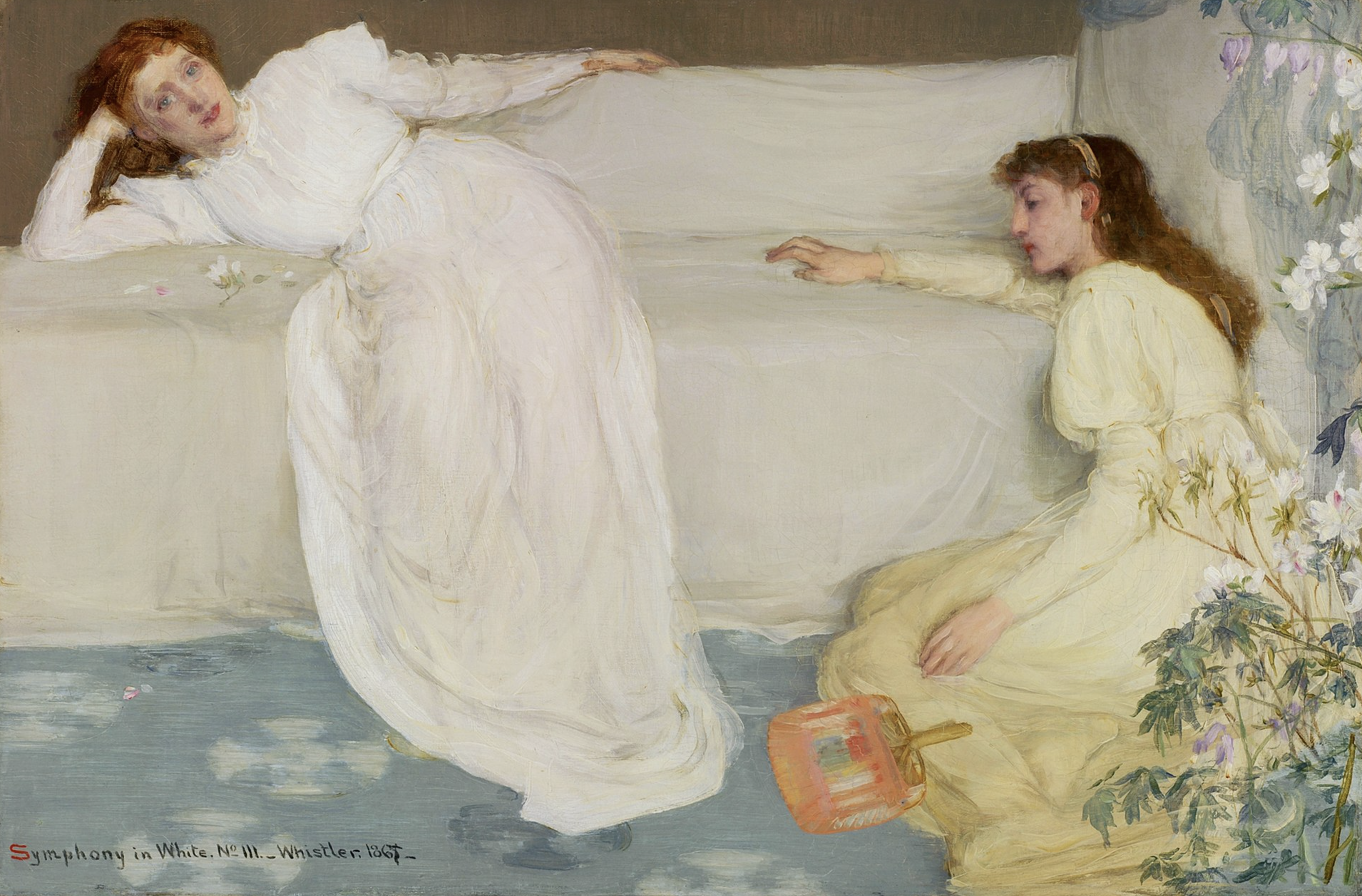
In August 1865 Whistler sent Fantin-Latour a sketch and detailed description of this painting when the artist considered the picture almost finished, with the figure on the right ‘tout ce que j’ai fait de plus pur’. Work on the picture was interrupted by Whistler’s dash for Valparaiso between February and September 1866. On his return he reworked the painting, notably the figure of the girl seated on the floor, before redating and exhibiting it at the Royal Academy in May 1867.
The picture shows Joanna Hiffernan at the left, wearing the white dress she wore in ‘The Little White Girl’ (no. 15). Seated on the floor is a professional model named Milly Jones, the wife of the actor Stuart Robson. Another exercise in white on white, the potential austerity is relieved by salmon pinks and oranges in the fan, pale purple flowers among the white azaleas, and a sky-blue durrie rug.
Early in 1867 Whistler’s brother took ‘Symphony in White, No. 3’ to Paris. Fantin, writing on 12 February of that year, congratulated Whistler on the picture’s success. He admired it wholeheartedly, apart from a certain ‘vagueness’, which, he said, made it look ‘like a dream’. But this was a minor fault. Fantin thought Jo’s head the best Whistler had ever done, and added that although Manet had not yet seen the picture, he had been told by the Belgian painter Alfred Stevens how good it was. Tissot, too, was ‘like a madman’ over it: he had ‘jumped for joy’. He also warned Whistler to ‘wait for these two gentlemen’s imitations’.
Whistler did not have to wait long. Though Manet himself paid Whistler the compliment of imitation in his famous portrait of Berthe Morisot, ‘Repose’, 1870 (Museum of Art, Rhode Island School of Design), the first artist directly to be inspired by ‘Symphony in White, No. 3’ was Degas. In a sketch of the picture, drawn either from Whistler’s sketch in the letter to Fantin or else from the picture itself during the winter of 1867, Degas effortlessly (and, one feels, instinctively) corrected its major fault, the awkward pose assumed by the model on the floor. Degas shifts her weight onto her left arm, which now supports her body, and allows the right arm to swing easily across her lap.
Clearly, what had interested Degas was the formal relationship between two women occupying different levels of the same space. When he came to adopt Whistler’s composition for his canvas ‘Mlle Fiocre in the Ballet “La Source”’, 1866–8 (Brooklyn Museum), he altered both poses so fundamentally that it is hard to see Whistler’s picture as a direct visual source.
For Whistler’s own visual source, one should not rule out Delacroix’s ‘Women of Algiers in their Apartment’, 1834 (fig. 4 on p. 16), which had been exhibited in Paris in 1864, as the inspiration for the languorous woman seated on the floor. Though one cannot point to it as a formal source for any single figure in ‘Symphony in White, No. 3’, as in the ‘Six Projects’ (see pp. 92–4) and ‘The Balcony’ (see no. 24), Whistler was intensely aware of the art of both Delacroix and Ingres and may have been seeking to unite the draughtsmanship of the one with the sensuous painterly qualities of the other.
A more immediate source of inspiration is that of the English painter Albert Moore, whom Whistler met in 1865. In his letter to Fantin of 17 August 1865 he proposed that Moore replace Legros as the third member of the Société des Trois, announcing that the three of them would carry on the ‘true tradition of 19th century painting’ — a tradition which embraced Delacroix, no less than Ingres. Moore’s ‘The Marble Bench’ (whereabouts unknown), exhibited at the Royal Academy in 1865, showed three girls in white draperies seated or reclining on a white marble bench. An early sketch for ‘Symphony in White, No. 2’ (Munson-Williams-Proctor Institute, Utica; M 323) is also closely related to Albert Moore’s ‘The Musician’, 1867 (Yale Centre for British Art, New Haven).
This was the first of Whistler’s pictures to be exhibited under a musical title. The critic of the Saturday Review, P. G. Hamerton, who had savaged ‘The White Girl’ in his review of the Salon des Refusés in 1863, announced that it was ‘not precisely a symphony in white’, inasmuch as he could spot notes of yellow, brown, blue, red and green in the composition. Whistler’s exasperated retort is justly celebrated: ‘does [Hamerton] then ... believe that a symphony in F contains no other note, but shall be a continued repetition of F, F, F? ... Fool!’
Inventory number: No.39.24
Provenance: Purchased 1939 |